Chapter 3
What the Mirror Reads
Not your wishes. Not your words. What you take for granted.
Tomas wanted a relationship. He wrote it in his journal and made a vision board with two coffee cups on a balcony. He meant every word of it, and for six years nothing happened.
One evening a friend asked him a strange question. “When you imagine actually being with someone (not the balcony, the real thing, a Tuesday evening), what do you feel?”
Tomas was quiet for a long time. He tried to picture it honestly: someone on the other end of his sofa, the television on, nothing special happening. He expected warmth. What came instead was a kind of fatigue, settling into his shoulders. Then he said: “Tired. Like I’d have to perform. Like they’d find out.”
There it was, underneath the journal and the vision board, so familiar he had stopped hearing it: if someone really knew me, they would leave. That was what the mirror had been reading all along.
The mirror reads below the surface

In the first chapter we saw that the world answers you. Now we need to be precise about which part of you it answers, because this is where most people go wrong.
You have, roughly, three layers. On the surface are your words: what you say and what you post. Below them are your wishes, what you want and hope for. And below both, deep and quiet, are your assumptions: what you take as simply, obviously true about yourself and the world, which is to say what you expect.
The mirror always reads the deepest layer. You can say “I am confident.” You can wish to be confident. But if, deep down, you assume you will be found out, the mirror reflects someone waiting to be found out. And the world arranges itself, with astonishing creativity, to find you out.
The mirror doesn’t read what you want. It reads what you expect.
How to find your assumptions
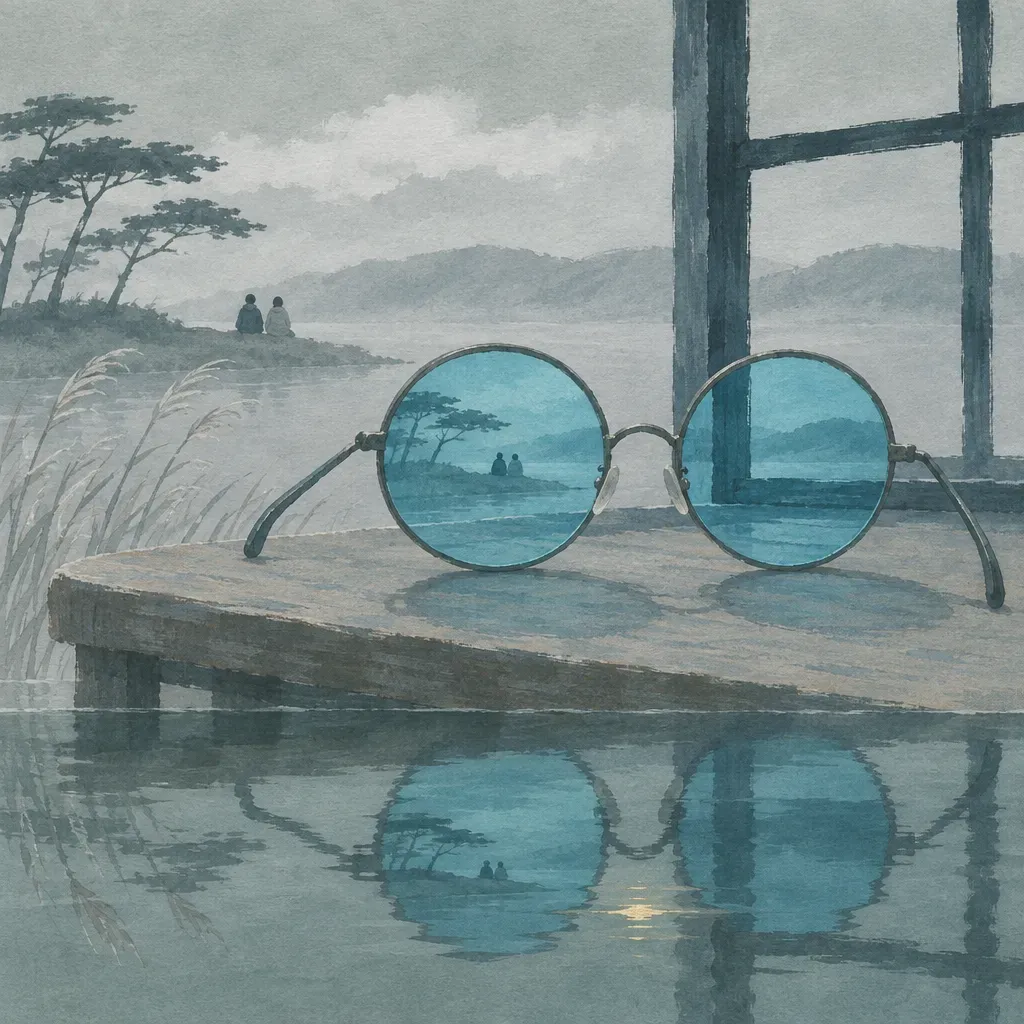
Assumptions are hard to see for the same reason you can’t see your own eyes. You don’t look at them, you look through them. They feel like the way things are.
A closer lookAssumptions are hard to see for…
You can see a hundred things today, but you will not see the thing you are seeing with. Your assumptions work exactly this way. They are not in front of you. They are behind your eyes, shaping how everything in front of you looks.
That is why it is no use asking yourself “What do I assume?” while you sit in a quiet room. The question comes back empty, because an assumption doesn’t feel like an assumption. It feels like weather, like facts, like “obviously.”
So you don’t look at them. You catch them in their effects, the way you see the wind in the trees without ever seeing the wind. Here are three places to watch:
Your surprise. When something good happens and part of you tenses, waiting for the catch, that tension is an assumption showing itself: “good things have a price.”
Your shortcuts. What do you decide about a person within the first ten seconds? What do you decide about an unopened envelope? Those fast, effortless conclusions are assumptions at work.
Your jokes. The things you say lightly about yourself, “typical me,” “I’m hopeless at this,” “I always do that,” are often the plainest confession of what you expect.
This week, carry a small note on your phone and call it “the wind.” Whenever you notice a surprise, a shortcut or a joke, write one line. You are not fixing anything. You are collecting the transcript. By Sunday you will have read your own deep layer, in your own handwriting, and nothing will have the power to surprise you about your reflection again.
But there is a reliable way to find them: look at your life, and ask what someone would have to believe to create exactly this.
If money always seems to slip away just after it arrives, what would you have to assume? Perhaps: money doesn’t stay with people like me. If every new job starts well and then sours, what is underneath? Perhaps: good things don’t last.
You don’t need to dig into the past to find these, or to blame anyone for installing them. Just look at the pattern in the reflection and read it backwards. The reflection is an honest transcript of what you assume, which is exactly why it’s useful.
There’s a second place to look, and it’s even more honest: what you prepare for. Nobody packs an umbrella on a day they assume will be dry. Look at your preparations and you’ll catch your assumptions in the act. The speech you rehearse in the car for an argument that hasn’t happened, say, or the way you check your phone three times after sending a message, bracing for silence. Each of these is an assumption that has already put its coat on and is waiting by the door.
A woman who assumes she’ll be welcome walks into a party without an exit plan. A man who assumes he’ll be overlooked arrives with one, and stands near the coats. Ask either of them what they believe and they’ll tell you they don’t believe anything in particular; they’re only being practical.
Why wishing can make it worse

Here is something that may sting a little, so read it gently.
Strong wishing often reflects lack. When you want something desperately, the wanting itself contains an assumption: I don’t have this, and I’m not sure I can. The harder you wish, the louder that assumption speaks. And the mirror, which reads the deep layer, reflects the not having. This is why the person who longs most for love often feels most alone, and the person who chases money hardest often feels poorest. Longing itself is fine. It’s the longing that grows out of a sense of lack that plants more lack.
A closer lookStrong wishing often reflects lack
This sentence can sting, so let us handle it carefully and kindly.
It does not say that wanting is wrong. Wanting is how the future first speaks to you. It says that the flavour of the wanting matters. There is a wanting that is warm and curious, like looking forward to a holiday you know you are taking. And there is a wanting that is tight and urgent, like gripping a railing on a moving bus. The second kind carries a hidden sentence inside it: “I don’t have this, and I might never.”
The mirror reads the hidden sentence, not the visible wish.
You can feel the difference in your body. Think of something you want. If your chest tightens, your jaw sets, and part of you feels you must make it happen now, that is grip. If something lifts, and you feel a gentle readiness, that is welcome.
What can you do? Not suppress the wish. Soften the hand around it. When the grip arrives, try three things in order. First, name it: “This is grip.” Second, breathe out slowly, longer than you breathe in, three times. Third, ask: “If I already had this, what would I be doing this evening?” and do a small piece of that.
The goal is not to stop wanting. It is to want the way you want tomorrow’s sunrise: confidently, without effort, without checking the clock. That wanting does not push the door. It simply expects it to open, and the mirror reads the expectation.
Compare this with something you never wish for, because you simply assume it. You don’t wish that the floor will hold you when you get out of bed. You don’t make vision boards about your heart beating tomorrow. You just know. And because you know, it isn’t even a question. That relaxed, unquestioning knowing is what the mirror reads most clearly.
So the work is to move what you want out of the layer of wishing and into the layer of assuming.
Taking away, not adding
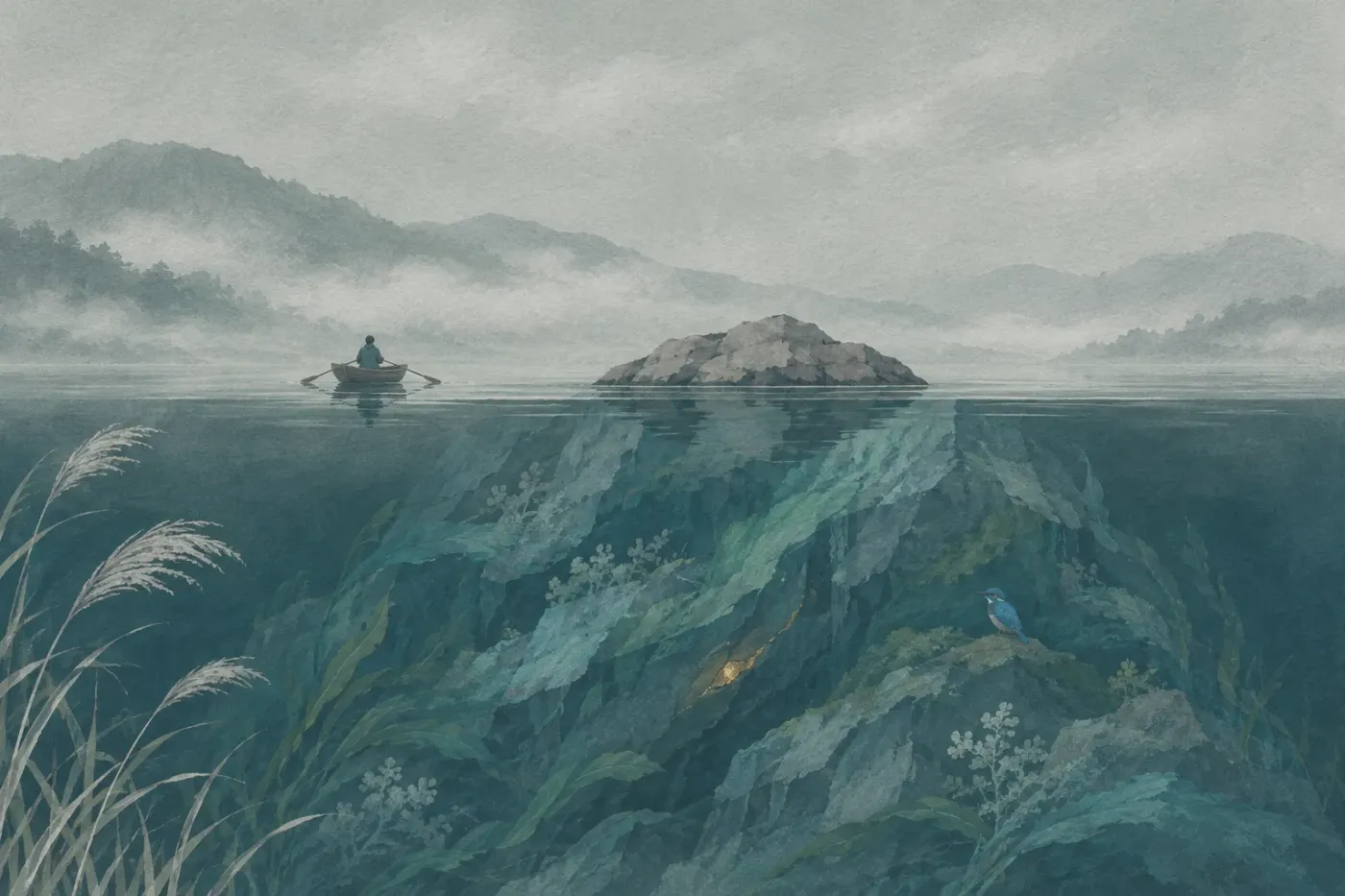
People usually imagine that getting what they want means adding something: more effort, more hours of visualising. Look at the lake again. Nobody adds mountains to it; they are already standing there, and the lake only has to stop moving.
Most of the work of commanding your reality is like that. You take away the what if and the people like me don’t. When enough of those are gone, what’s left is a quiet expectation, and quiet expectation is exactly what the mirror shows back.
Doubt is the one thing standing in the way. And doubt is so convincing because it dresses up as information. What if it doesn’t happen? sounds like a sober question. Look closer and it’s only one possibility out of countless others, one you happened to pick up and hold to the light. The fearful outcome is no more real than the good one; it simply has your attention right now.
That’s worth saying plainly: there are very few facts in your future, only possibilities that somebody, usually you, has accepted as facts.
Changing the assumption
So how do you move something from wishing to assuming? Not by force. You can’t bully your deep layer. It doesn’t respond to shouting, only to familiarity.
A closer lookYou can't bully your deep layer
Many of us treat our own mind like a stubborn employee. If it doesn’t do what we want, we shout louder: affirmations through clenched teeth, vision boards stared at with desperation, “I WILL be confident” repeated like an order.
And nothing happens, or something worse happens: the deep layer answers back. “Who are you kidding?” That small, tired voice is not your enemy. It is the layer that has been signing the paperwork for years, and it simply doesn’t take orders from the surface.
What it does respond to is familiarity. Think about how you learned the way to your door. Nobody commanded you to know it. You walked it so many times that your feet know it without you. In the same way, a new assumption becomes yours through small, repeated, felt visits.
So make the visits small and easy. If you want to assume that you are welcome, don’t try to feel welcome in a stadium. Walk into one shop today as if you belong there. Say hello first. If you want to assume that there is enough, pay one small bill gently and with thanks instead of dread. These are visits. Each one is a footstep on a new path.
And keep the new sentence kind and believable: “Of course this can work out.” “Of course there’s a way.” You don’t need to believe it fully. You need to let it stand in front of the mirror, day after day, until it stops feeling like a coat you are trying on, and starts feeling like yours.
Assumptions are made of repetition and feeling. You didn’t decide that “good things don’t last.” You felt it, again and again, until it became the water you swim in. The new assumption is built the same way: through small experiences of the new truth, felt and repeated. The rest of this book gives you instruments for that, one by one. You will learn to read your emotions as a compass, to find and rewrite the quiet contracts you signed long ago, to change the voice that narrates your life, to live from the end, and to rehearse in imagination until the new picture feels as ordinary as the old one did. Each of these is a way of reaching the deep layer.
For now, start with something simpler, and catch yourself assuming. When you notice a sentence in you that begins with of course (“of course this will go wrong,” “of course they’ll say no”), stop. That of course is the sound of an assumption. Ask: is this really how it must be, or is it only how I’ve always expected it to be?
Then try a new of course, gently, the way you’d try on a coat. Of course this can work out. Of course I’m allowed to rest. You don’t have to believe it fully. You just have to let it stand in front of the mirror for a while.
Don’t wrestle
When you start catching your assumptions, you’ll be tempted to fight them. You’ll hear of course they’ll say no and want to argue it to the ground, with reasons and counter-examples. It feels like progress, but whatever you wrestle, you’re holding. The longer the fight, the more attention the old thought gets, and attention is what keeps an assumption alive.
Replace it instead. Your mind can only hold one thought in front at a time. When the old one shows up, don’t push it out. Put the new one next to it and turn toward the new one, the way you’d turn from a loud stranger toward a friend who just walked in. Of course they’ll say no. Notice it. Or they’ll say yes, and I’ll be glad I asked. Then go on with your day.
Do it a hundred times if you have to. It gets faster. Every thought you think on purpose is a small vote for a version of your life, and the deep layer counts votes, caring far less how eloquent they are than how many.
Keep it to yourself for a while
A new assumption is young. It hasn’t got roots yet, and the easiest way to damage it is to hold it up for everyone to inspect.
You tell a friend, full of hope, that you’ve decided this year is the year your work finally finds its people. Your friend loves you, and so your friend worries for you. Just don’t get your hopes up. One sentence, said kindly, and you walk home carrying their doubt on top of your own.
So for now, keep it private. Let it live in you, quietly, the way a seed lives under the soil without anyone digging it up to check. Later, when the new assumption is as solid as the floor, you can talk about it with anyone you like, and nobody’s doubt will reach it.
What Tomas did

Tomas didn’t make a new vision board. He did something much smaller: he began noticing every moment when someone saw him clearly and stayed. The sister who knew his worst habits and called him every Sunday anyway. The old friend who had seen him at his lowest and still sent him songs.
He had been surrounded by people who knew him and stayed. He had just never counted them, because they didn’t fit the assumption.
He didn’t tell anyone what he was doing. Week by week, the old sentence lost its grip. Some evenings it came back at full volume, usually after a quiet weekend, and he let it talk and then turned, deliberately, to one of the names on his list. A new sentence took its place, slowly: people who really know me tend to stay. He never announced it, and the mirror read it anyway.
The relationship, when it came a year later, didn’t start on a balcony. It started on a Tuesday evening. Months in, he noticed something in the middle of an ordinary night on the sofa, the television on, nothing special happening. He wasn’t tired, and he wasn’t performing. He was simply there, and so was she.
Today, listen for your “of course”, and ask whether it’s really true.